Source detergent free magic sponge for Kitchen, Bath, and Car Cleaning
Find and compare 30 listings for detergent free magic sponge suitable for kitchen, bath, and car cleaning. Review specifications including sponge material, various shapes, and customizable packaging options from suppliers in China.
Key considerations
Products List




Comprehensive Sourcing Guide
Detergent Free Magic Sponge Sourcing Guide
Detergent free magic sponges—commonly known as melamine foam erasers—have become a staple item in the household cleaning category because they clean through physical abrasion rather than chemical action. For B2B buyers, this positions the product attractively for grocery chains, dollar stores, janitorial distributors, and e-commerce resellers who want a low-unit-cost cleaning product with broad consumer appeal. The listing data observed across 30 product pages confirms an active supplier base concentrated in China, with origins listed in Shanghai and mainland China more broadly, and product models such as QM2456-53, QM2022022-5, QM2024-53, QM2024-25, QM0053, FYH3104, FYH3112, FY03333, 905026, MSOK-044, MSOK-076, and okhm appearing in current offers.
The purpose of this guide is to help procurement teams move from browsing listings to structuring a defensible sourcing program. Because the product is simple in appearance but variable in quality, density, and sizing, disciplined verification of specifications, packaging, and supplier capability matters more than it might for a commodity with visible mechanical complexity. The sections below walk through the product scope, the technical parameters worth confirming in writing, the documentation buyers should request, the commercial levers that shape landed cost, the qualification steps that separate capable factories from trading intermediaries, and the ongoing checks that protect a long-running supply relationship.
Product Scope and Observed Listing Signals
The observed listings cluster tightly around small-format eraser pads intended primarily for kitchen use, with several listings extending usage claims to bath and car cleaning. This aligns with trusted category knowledge: melamine foam sponges are marketed as detergent free because the foam's open-pore microstructure does the work, making them suitable for kitchen countertops, sinks, stovetops, ceramic tiles, and similar hard surfaces. Buyers should treat listed usage claims—"Kitchen," "Kitchen,Bath," "Kitchen,Bath,Car," and "Car"—as supplier-stated positioning rather than independently validated performance, and should confirm surface-compatibility expectations with their own sampling before making marketing claims on packaging.
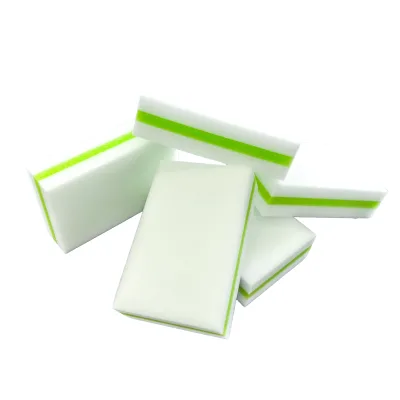
Several structural signals from the listings deserve attention. Material is consistently stated as sponge (melamine foam), with colors including White, Grey+White, Green+Yellow, Black+White, and Black+Red, and "Various Shapes" offered under customization. Every listing observed carries customization availability, and at least one explicitly flags OEM acceptance with online sales channels and a global market target. Packing methods vary—OPP bag, bag plus carton, bulk packing, and general carton packing—which directly affects per-unit presentation and retail readiness. The listed standard sizes cluster around 100x65x20mm, 100x70x30mm, and 100x65x25mm, with smaller formats at 11.5x7.5x1.8cm and 11x7x2cm, and a larger 20x10.5x6cm option, indicating the supplier base can serve both retail counter packs and bulk janitorial formats.
Technical Specifications to Verify
Melamine foam performance depends heavily on parameters that do not show up in listing photos, so a written specification sheet should be the first artifact every buyer obtains. Density is the single most influential variable: higher-density foam generally erodes more slowly and delivers more cleanings per sponge, while lower-density foam cuts faster and wears quickly. Compressive resistance and pore structure follow from density. None of the observed listings state a density value, so buyers should request it explicitly and compare samples across candidate suppliers under identical test conditions—same stain type, same stroke count, same surface—before committing to a model such as QM0053 or FY03333.
Dimensional tolerance is the second critical verification. The listed sizes (for example, 100x70x30mm or "according to your requirements") suggest suppliers will cut to buyer specification, which is an advantage but also a source of variance. Confirm whether dimensions are nominal with a stated tolerance band, and require the supplier to hold that band across the production run rather than only in the golden sample. Also verify whether compression during packing and shipping causes dimensional or structural changes—thin formats like the 11.5x7.5x1.8cm pads are more prone to edge crumbling. Finally, confirm color consistency for non-white variants such as Black+Red or Green+Yellow, since melamine foam coloration is an added process step with its own batch-consistency risk.
Compliance and Safety Documentation
The listing data provides no certification information whatsoever, which means buyers must treat compliance as an open item for every candidate supplier. For a cleaning product that contacts food-preparation surfaces in kitchen use, the core concern is chemical safety of the foam itself and of any colorants or additives used in dyed variants. Buyers should ask suppliers for the material composition of the melamine foam, safety data sheets for the raw foam, and—where the target market requires it—third-party test reports covering relevant chemical substance restrictions. Do not accept supplier assertions that a product "passes" a regulation without seeing the underlying report, and do not assume a report provided for one model covers a different model or color variant.
Regulatory scope differs by destination market, so build the documentation request around where the goods will be sold rather than accepting a generic compliance package. For consumer retail in regulated markets, buyers typically need to confirm restrictions on hazardous substances, packaging material declarations, and labeling requirements including fiber-content or material identification where applicable. For dyed variants, request confirmation that the colorant is applied in a manner suitable for the intended wet-use application and will not transfer to hands or surfaces. Buyers importing into markets with formal product-safety regimes should also verify that the supplier can support recall or traceability processes through batch coding, since a low-cost commodity item is not exempt from consumer-protection obligations.
Cost Drivers and Commercial Terms
The observed price range of roughly $0.03 to $1 per piece reflects the fundamental economics of this category: melamine foam is inexpensive in raw form, and cost is driven primarily by density, size, thickness, coloration, and packaging rather than by manufacturing complexity. A large white pad cut in bulk will sit at the bottom of that range, while a smaller colored pad in an OPP bag with retail-ready presentation will sit higher. Buyers should normalize quotes to a cost-per-useful-cleaning basis rather than cost-per-piece, because a cheaper low-density sponge that wears out in half the cleaning sessions may be more expensive in effective terms.
Commercial terms in the observed listings also show meaningful variance that shapes total landed cost. MOQs observed span from 1 piece to 10,000, with specific listings stating 1000-piece minimums—so buyers with small trial volumes can find entry points, while volume pricing requires negotiating against the higher tiers. Packaging choices (OPP bag, bulk, bag-plus-carton with a stated 55x55x50cm carton holding 800 pieces) affect both freight density and per-unit packing labor. When comparing quotes, ask each supplier to break out unit price by packaging option and to state carton dimensions and pieces per carton, since container utilization on a bulky low-density product materially changes the freight component of landed cost. Customization (size, color, shape, packaging print) is widely available but usually carries tooling or setup considerations that should be quoted separately from the standard-item price.
Supplier Qualification and Quality Control
Qualifying a magic sponge supplier should focus on manufacturing capability rather than listing polish. The consistency of Shanghai and mainland-China origins in the data suggests a genuine production cluster, but buyers should still verify whether each candidate owns foam cutting and converting equipment or is a trader reselling from multiple workshops—this affects quality consistency, communication speed, and problem resolution. Request photos or a video walkthrough of production areas, confirm in-house versus outsourced processes (foam slicing, die-cutting, coloration, packing), and ask which of the listed models the supplier actually produces versus brokers. A supplier showing multiple models such as MSOK-044 and MSOK-076 with differing carton configurations may be aggregating rather than manufacturing.
Quality control should be built around the parameters verified earlier: density consistency, dimensional tolerance, edge integrity, and packing accuracy. Define an inspection protocol before the first order—typically incoming checks on raw foam batches, in-process checks on cut dimensions, and pre-shipment AQL sampling covering dimensions, weight (a practical proxy for density), visual defects, and carton counts. Require the supplier to retain retain-samples from each shipment lot so that any later complaint can be traced. For the first order, consider a pilot quantity near the lower end of the observed MOQ range to validate real-world performance before scaling, and make the inspection standard and remedies for nonconforming goods explicit terms of the purchase contract rather than informal understandings.
Long-Term Procurement Checks
Once a supplier relationship is established, the priorities shift from qualification to consistency and continuity. Melamine foam raw material markets can shift, and a supplier under cost pressure may quietly lower foam density—the buyer may not notice until end-consumer wear-complaints rise. Institute a periodic reference-sample program: keep sealed retained samples from each approved production lot and re-compare current shipments against them at defined intervals, checking weight per pad and cleaning performance. Track the defect rate across incoming inspections over time and review the trend with the supplier in scheduled business reviews rather than only when problems surface.
Supply continuity and commercial stability complete the long-term picture. Confirm the supplier's raw-material sourcing arrangement and whether they can hold a locked specification across multiple production campaigns; if customization was part of the original deal (sizes cut to buyer requirements, specific color combinations, printed packaging), verify that tooling, cutting patterns, and artwork files are documented and reproducible. Monitor packaging and carton configuration over time as well—a change in carton size or pieces per carton can silently alter freight costs and warehouse handling. Finally, maintain a qualified secondary source that has passed the same specification and sample validation, so that pricing negotiations, capacity constraints, or quality stumbles at the primary supplier do not force an emergency requalification under time pressure.
FAQs
What materials are used for detergent free magic sponges?
These sponges are primarily made from melamine foam, often referred to as sponge material in product listings. This open-cell structure allows the foam to act as a fine abrasive that lifts dirt without the need for chemical detergents. The material is durable and effective for various cleaning tasks in kitchens and bathrooms.
Can these sponges be customized for specific branding needs?
Yes, customization is available for many of these products. Buyers can often request specific colors such as green, yellow, black, or white combinations. Some suppliers also offer OEM services to tailor the product to specific brand requirements, ensuring the final item meets unique marketing or functional needs.
What are the standard packaging options for bulk orders?
Packaging varies by supplier but commonly includes OPP bags, carton boxes, or bulk packing. Some items are packed in OPP bags for individual retail, while larger orders may use cartons with specific quantities per box. Buyers should verify the exact packaging way, such as bag plus carton, to ensure safe transport.
Which industries commonly use these cleaning sponges?
These sponges are widely used in kitchen, bath, and car cleaning applications. Their versatile design allows them to remove stains from various surfaces without harsh chemicals. This makes them suitable for household use, automotive detailing, and commercial cleaning services that require effective, detergent-free cleaning solutions.
What are the typical dimensions for these sponge products?
Standard sizes often include dimensions like 100x65x20mm, 100x70x30mm, or 11.5x7.5x1.8cm. Some products are available in larger sizes such as 20x10.5x6cm. Buyers can often request custom sizes according to their specific requirements, ensuring the sponge fits their intended cleaning tools or packaging constraints.
How does the MOQ affect pricing for these sponges?
The minimum order quantity typically ranges from 1 to 10,000 pieces, with some suppliers setting an MOQ of 1,000 pieces. Higher volumes often lead to better unit pricing. Buyers should check the specific MOQ requirements for each model to understand the cost implications and ensure they meet the supplier's threshold.